
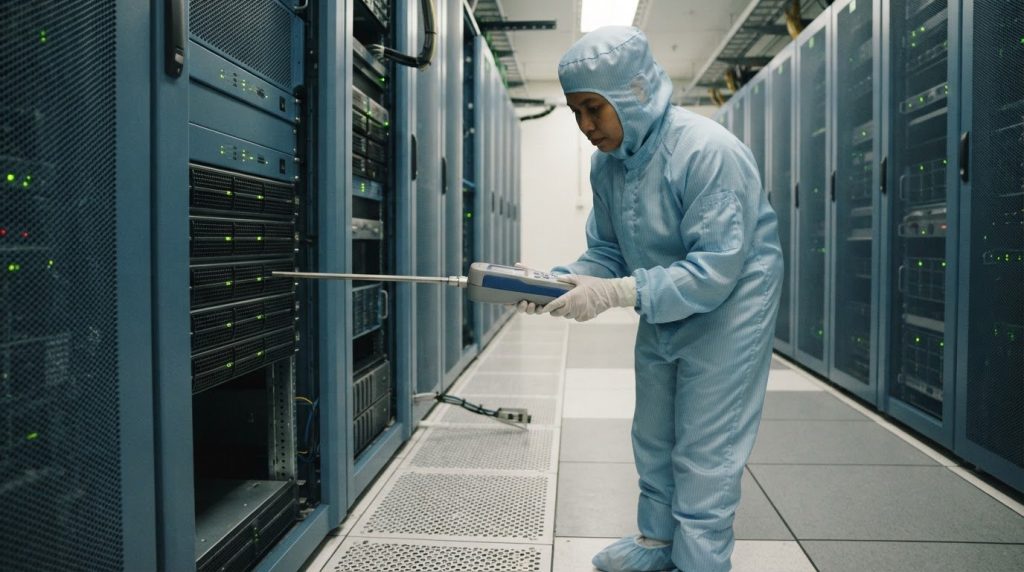
A cleanroom certificate is useful only when it reflects the conditions a data center must control. Cleanroom certification for data centers assesses whether airborne particle levels meet a specified cleanliness class; according to the International Organization for Standardization, ISO 14644-1 classifies cleanrooms by particle concentration per cubic metre.
That classification matters, but it does not tell the whole story. Operators also need to understand how airflow, filtration and operating conditions affect contamination across equipment areas and the wider facility.
This article explains what certification means, how ISO 14644-1 classes apply to data centers, and what testing can reveal about particle levels and airflow. You’ll also see why an air quality assessment can provide practical insight into environmental conditions, helping facility teams make informed decisions about contamination control and cleanroom performance.
Key Takeaways
- Choose a cleanliness class that reflects the facility’s operating needs; the classification alone doesn’t describe every aspect of environmental performance.
- Particle-count results show airborne contamination levels, while airflow testing helps reveal how air moves through the space.
- Testing under operating conditions can show whether cleanliness performance is maintained when equipment is running.
- Assess filtration, airflow distribution and potential contamination sources together to build a more useful picture of air quality.
- Cleanroom Performance Testing, TAB and air quality assessment can help facility teams evaluate performance and identify areas for further investigation.
What is a Data Center Cleanroom?
A data center cleanroom is a controlled facility where airborne particle levels are measured against a defined cleanliness class. ISO 14644-1 classifies cleanrooms by particle concentration per cubic metre, according to the International Organization for Standardization. For data center operators, the purpose is to assess contamination conditions around IT equipment, not to assume the room has the same requirements as a manufacturing cleanroom.
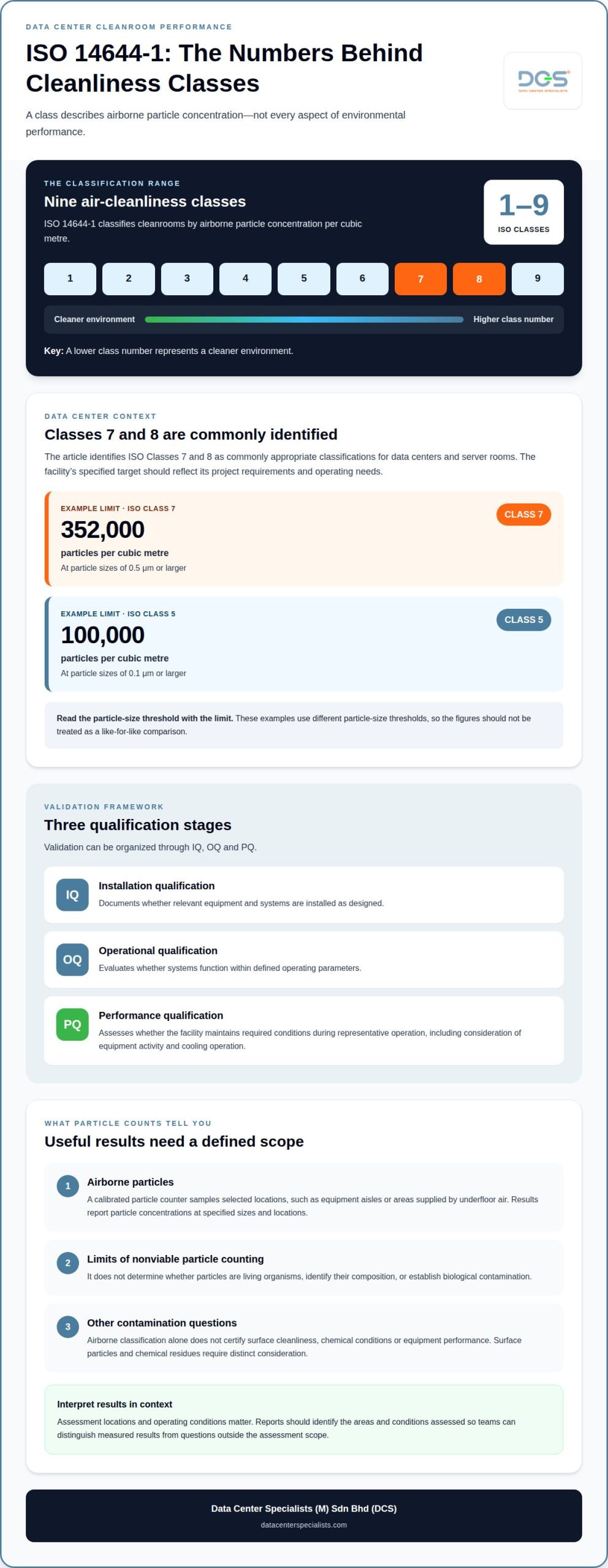
Cleanroom certification for data centers evaluates whether measured conditions meet a specified classification. ISO Class 7 permits a maximum of 352,000 particles per cubic metre at particle sizes of 0.5 μm or larger. ISO Class 5 permits a maximum of 100,000 particles per cubic metre at particle sizes of 0.1 μm or larger. These examples show why a class must be read alongside its particle-size threshold.
Validation can also be organized through IQ, OQ and PQ. Installation qualification (IQ) documents whether relevant equipment and systems are installed as designed. Operational qualification (OQ) evaluates whether they function within defined operating parameters. Performance qualification (PQ) assesses whether the facility maintains required conditions during representative operation. In a data center, this may involve considering equipment activity and cooling operation when evaluating environmental performance.
Nonviable particle counting measures airborne particles without determining whether they are living organisms. A calibrated particle counter samples air at selected locations, such as equipment aisles or areas supplied by underfloor air. Results show particle concentrations at specified sizes and locations, but do not identify particle composition or establish biological contamination. Sampling locations and operating conditions are therefore important when interpreting the results.
Airborne counts do not describe every contamination pathway. Surface particle cleanliness concerns material deposited on racks, raised floors or work surfaces. Chemical cleanliness concerns residues or vapours that particle counts alone cannot identify. These are distinct assessment questions: a room may meet an airborne particle classification while still needing attention to surface dust or chemical residue. Humidity and airflow can affect how contaminants move or settle, so interpret measurements in the context of facility operation.
Keep the scope clear. A data center particle-count classification describes airborne particulate concentration; by itself, it does not certify all surfaces, chemical conditions or equipment performance. The report should identify the areas and conditions assessed, so readers can distinguish measured results from environmental questions beyond the scope. This helps facility teams apply findings accurately when reviewing contamination controls and planning further assessment.
ISO 14644-1 cleanliness classifications
For data centers in Malaysia, ISO 14644-1 offers an international framework for classifying airborne cleanliness. The appropriate class should follow the facility’s project specification and operational requirements, rather than being assumed from its location.
ISO 14644-1 Air-Cleanliness Classes
ISO 14644-1 defines air-cleanliness classes according to airborne particle concentration, with classifications spanning Classes 1-9. The class gives operators and project teams a common reference for specifying and assessing particulate cleanliness. A lower class represents a cleaner environment, so selecting a target requires understanding the equipment environment and the project’s stated needs.
For data centers and server rooms, Classes 7 and 8 are identified as commonly appropriate classifications. The distinction matters: a facility’s target should be written into its project requirements, then assessed using particle measurements at representative locations. A general cleanroom label alone doesn’t show whether the chosen class matches the intended operating conditions.
ISO 14644 and Federal Standard 209E
ISO 14644 is an international standards series for cleanrooms, while Federal Standard 209E is a separate, older classification system. The General Services Administration officially cancelled Federal Standard 209E on November 29, 2001. Its former terminology may still appear in historical facility records or validation documents.
For current specifications, name the classification system and class explicitly rather than treating labels from different systems as interchangeable. This helps project teams compare requirements consistently and prevents confusion when reviewing older documents. ISO 14644-1 is the relevant reference for stating an air-cleanliness class under the ISO system.
Particle concentration is the basis of the ISO 14644-1 classification, but the class should not be treated as a complete description of facility performance. It describes airborne particulate cleanliness, not every environmental condition or contamination source. Operators should keep the specified class distinct from other requirements, such as airflow performance, surface cleanliness or chemical contamination controls.
Set the requirement before testing. A project specification should identify the classification system, target class, relevant particle-size considerations and the conditions for assessment. This gives commissioning and operations teams a clear reference for interpreting results and helps maintain consistency when comparing different areas or assessment periods.
For a data center project, align the specified class with the intended use of each controlled area. An equipment room and a more tightly controlled technical space may have different requirements. Where particle classification forms part of performance verification, Cleanroom Performance Testing can assess conditions against the defined criteria.
Cleanroom certification and compliance testing
Certification compares measured conditions with a defined cleanliness class and testing scope. For data centers, interpret particle results alongside operating conditions and environmental controls.
Certification and Routine Testing
Cleanroom certification documents whether measurements meet a specified classification; routine testing monitors performance over time. ISO 14644-2 specifies monitoring and testing requirements for cleanrooms and clean zones. Certification is typically performed every 6 to 12 months, or after a major system upgrade or maintenance. The interval helps operators identify changed conditions and assess continued performance against their stated criteria.
The testing scope should specify sampling locations, operating state, particle sizes and reporting requirements. Controlled production environments—such as those maintained by supplement contract manufacturer Harmony Pharma Lab—operate under vastly different cleanliness objectives than a data center, meaning each testing plan must reflect its specific facility rather than copying another industry’s specification.
Data Center Environmental Testing
Data center environmental testing evaluates measurable conditions that affect equipment areas, including airborne particles, airflow, temperature, humidity, pressure and filtration performance. The project’s documented operating limits provide the comparison criteria; no single set of values applies to every facility. This distinction helps teams interpret results without treating one cleanliness class as a complete environmental assessment.
Particle counters measure airborne concentrations at selected locations. Airflow assessment examines how air is distributed and moves through the controlled space, while filter integrity testing can identify media defects or bypass leakage. For performance qualification, particle counts can be taken while servers operate to show whether the room maintains its class under actual thermal loads.
Certification Requirements and Comparisons
Cleanroom classification, data center infrastructure assessment and information-security certification address different scopes. ISO 14644 concerns cleanroom cleanliness; Uptime Institute and ISO 27001 certifications should not be treated as substitutes for particle testing. The distinction matters because a facility’s status in one area does not establish its airborne cleanliness performance.
In Malaysia, project documents should state the required ISO class alongside applicable contractual and facility criteria. The cleanroom class defines particle cleanliness; temperature, humidity, pressure and filtration limits need their own documented acceptance criteria. Testing assesses these conditions against the requirements set for the facility.
Certification cost depends on the case and is provided after a quote request. The testing scope, sampling locations, site access and reporting requirements all affect the work involved.
Testing Duration and Recertification
Testing duration depends on the sampling scope, access arrangements, operating conditions and reporting requirements. A focused assessment and a facility-wide evaluation need different measurement plans, so the scope determines the sequence and time required for fieldwork and analysis.
Recertification is typically performed every 6 to 12 months, or after a major system upgrade or maintenance. Operators should also consider whether changes to filtration, airflow or room configuration affect the original test conditions. Documenting those changes helps teams interpret later results against the correct baseline.
Airflow volume and velocity
Airflow testing examines how much air moves through a data center and how it travels around equipment. Volume describes the quantity supplied over time, while velocity describes air speed at a measured location. Both help operators assess whether the designed airflow path supports cooling and limits contaminant movement. For example, a reading at a floor grille represents that point, not necessarily the entire room.
Airflow volume and distribution
In raised-floor data centers, the plenum can distribute cold air toward floor grilles and equipment aisles. Testing considers the available supply, grille output and return-air path as a connected system. A blocked opening or poorly positioned floor tile can change local air delivery, even when the wider air-handling system is operating. Measurements at representative locations help reveal uneven distribution.
Volume and velocity readings answer different questions. A velocity measurement describes movement at a specific point, while a volume assessment considers airflow through an opening or duct. Record each reading with its location and operating condition. Comparing supply and return paths can help identify bypass flow, recirculation or areas where air does not reach the intended equipment intake.
Airflow patterns and visualization
Airflow patterns describe the direction and interaction of supply and return air. In a cold-aisle arrangement, supply air is directed toward equipment intakes, while hot exhaust should follow a return path. Poor separation can allow hot air to recirculate toward the intakes. Airflow visualization makes these patterns visible, helping teams investigate unexpected mixing around racks, openings or containment boundaries.
Airflow visualization complements measurements; it does not replace them. A visible tracer can show direction and reveal stagnation or crossflow at a specific point. Results depend on the tested operating configuration, including active equipment and open floor panels. Documenting the setup lets engineers interpret the observed airflow alongside temperature conditions and measured grille output.
CFD airflow modelling
Computational fluid dynamics (CFD) modelling represents airflow and heat movement in a digital model of the facility. Engineers use inputs such as room geometry, equipment arrangement, supply locations and operating assumptions to examine possible flow patterns. The model can help assess a proposed layout or investigate a suspected hotspot before physical changes are made.
A CFD result is a model, not an on-site measurement. Its usefulness depends on the quality of its inputs and how closely its assumptions match facility operation. Compare model findings with field readings and observed airflow visualization. If the model predicts a clear supply path but measurements show uneven grille delivery, review the assumptions and actual conditions before choosing corrective action.
Use airflow assessment to connect cooling performance with contamination control. Filters and well-designed airflow paths support controlled conditions, but changes in airflow can redistribute particles. Testing should therefore document supply, return, equipment arrangement and operating state together. This gives facility teams a clearer basis for assessing whether the system maintains its intended pattern as electronic load and room configuration change.
Data center air quality assessments
A data center air quality assessment examines airborne particles, contamination sources and environmental conditions together. In operational facilities, a particle count is one measurement, not a complete diagnosis. Dust in a raised-floor plenum, residue on a rack and airborne zinc whiskers present different risks and require different investigative methods.
Start by defining the assessment area and operating state. Record whether servers are running, which cooling systems are active and where supply air enters. Then choose representative locations, such as equipment intakes, return-air paths and underfloor spaces. This context helps engineers interpret readings and identify patterns instead of treating a single result as representative of the entire facility.
Nonviable particle counting can quantify airborne particulate concentrations at specified sizes, but it does not identify particle composition. If counts indicate a concern, inspect likely sources, including construction residue, damaged finishes, filter bypass or disturbed deposits. Zinc whiskers deserve particular attention because these microscopic conductive filaments grow on surfaces plated with electro-galvanized zinc. Their conductive nature makes identifying the source relevant to contamination control.
Air quality work should distinguish particulate results from chemical cleanliness. A particle counter cannot establish whether a surface carries residue or whether airborne chemical contaminants are present. Surface inspection and targeted analysis address different questions. For example, visible deposits on a rack may call for a surface-focused investigation even if airborne counts meet the facility’s specified class.
Environmental readings add context. Temperature, humidity and airflow can influence how particles move, settle or interact with materials. A 40-60% relative humidity range is an example of moderate humidity associated with contaminant reactions in data centers. Treat it as contextual information, not a universal operating target; interpret readings against the facility’s own design and operating criteria.
Filtration review should include both filter condition and installation integrity. HEPA filters capture 99.97% of particles as small as 0.3 microns, but a filter’s rated performance alone does not establish system performance. A damaged seal or installation bypass can allow air to avoid the filter media. Inspect the assembly and assess leakage pathways when results suggest filtration may be compromised.
Useful documentation records sampling locations, operating conditions, instrument readings, observed contamination and follow-up actions. Compare results over time using consistent locations and similar operating states. This makes trends easier to interpret after construction work, maintenance or airflow changes. The practical outcome is a clearer basis for prioritizing source control, cleaning or further technical investigation.
For facilities in Malaysia, connect assessment findings to the site’s operational requirements and applicable project criteria rather than assuming one regulatory threshold governs every data center. A structured assessment can help teams determine whether the issue concerns airborne particles, deposited material, filtration or airflow, then select an appropriate response.
Data Center Specialists (M) Sdn Bhd (DCS): Professional Data Center ISO Cleaning Services
Data Center Specialists (M) Sdn Bhd (DCS) supports data center operators managing physical contamination and cleanroom performance. Its Professional Data Center ISO Cleaning Services address particulate contamination in mission-critical spaces, including areas where dust control matters to equipment operation. Cleaning methodology and ISO classification are distinct: cleaning helps control contamination, while testing evaluates environmental conditions against defined criteria.
For facilities that need measured performance data, Cleanroom Performance Testing (CPT) and Data Center Air Quality Assessment can help assess particle levels and relevant conditions. Testing, Adjusting & Balancing (TAB) is appropriate when airflow distribution also needs assessment. Consider these services after construction or maintenance, when facility conditions change, or when operational monitoring identifies a concern.
Contact Data Center Specialists (M) Sdn Bhd (DCS) to discuss your facility’s cleaning or testing requirements.
Turn Assessment Findings Into a Clear Facility Plan
The next step is to turn test findings into facility priorities. Separate immediate contamination concerns from longer-term airflow or energy questions, then document which conditions need monitoring. This gives operations and engineering teams a practical basis for planning work without treating a cleanliness classification as a complete measure of facility performance.
Cleanroom certification for data centers is most useful when its defined scope supports decisions about the operating environment. Data Center Specialists (M) Sdn Bhd (DCS) offers Professional Data Center ISO Cleaning Services, Data Center Energy Assessment, and Testing, Adjusting & Balancing (TAB). These services address distinct needs: physical contamination control, energy review and airflow balancing.
For a technical discussion about your facility’s assessment or service requirements, contact Data Center Specialists (M) Sdn Bhd (DCS). A clear scope is a sound starting point for informed operational planning.
Frequently Asked Questions
What is cleanroom certification?
Cleanroom certification provides a formal record of a facility’s assessed cleanliness performance against an agreed requirement. For operators, its practical value is a traceable reference for handover, change management and later comparisons. Check that the report identifies the tested area, assessment conditions and acceptance basis. This helps ensure a certificate for one room or operating state is not treated as evidence for every area or future configuration.
What ISO 14644 cleanroom classes are used in data centers?
Classes 7 and 8 are commonly identified for data centers, but a facility need not apply one class uniformly to every space. Set the target by area and use, then record it in project documents. For example, a technical room with a defined contamination-control objective may have a different specified class from adjacent support areas. This keeps procurement requirements, commissioning records and operational expectations aligned.
What are the steps to certify or validate a data center cleanroom?
Begin with the acceptance criteria, then coordinate assessment access with facility operations. Confirm which rooms and configurations are in scope, and arrange testing to represent normal operating conditions. After measurements, review any exceptions against the agreed criteria and assign follow-up actions to the responsible team. Retain the final report with commissioning or facility records, so later changes can be compared with the same documented baseline.
Which bodies provide cleanroom certification and testing in Malaysia?
Cleanroom performance testing in Malaysia is conducted by specialist testing providers; ISO publishes the classification standards but does not perform on-site testing. The available information does not identify a Malaysian government body that issues a universal data center cleanroom certificate. In procurement documents, distinguish the standard used, the party performing measurements and the organization issuing any report or certificate. This avoids confusing standards ownership with field testing.
What risks arise from failing cleanroom audits or certification?
A failed assessment can reveal a gap between documented acceptance criteria and measured facility conditions. The immediate task is to determine whether the cause relates to the room, filtration, airflow, contamination sources or test conditions. If the discrepancy remains unresolved, project handover or internal acceptance may be delayed when those criteria are contractual. Clear ownership of corrective actions helps operations teams manage the finding without confusing it with unrelated security or uptime certifications.
What are the requirements for temperature, humidity, pressure, and filtration in data center cleanrooms?
Assess temperature, humidity and pressure against the facility’s documented operating limits; there is no single set of values for every data center. Filter integrity testing can evaluate filtration performance and identify media defects or bypass leakage.
What Malaysian regulations or local requirements affect data center cleanroom certification?
The article identifies ISO 14644-1 as an international framework for classifying airborne cleanliness in Malaysia. The target class should follow the facility’s project specification and operational requirements, rather than being assumed from its location.