
What if a supplier passes a paperwork review but still creates operational risk for a critical facility? A vendor qualification checklist for critical facility services should go beyond certificates. It should cover compliance evidence, audit history, facilities and equipment, validation practices, financial stability, and operational resilience.
That broader view matters because a provider’s work can affect facility conditions, maintenance, and operational continuity. Procurement, quality assurance, engineering, and facility operations all have a role in qualification. The level of scrutiny should reflect the service’s criticality and the risks it introduces.
Use the checklist to set evidence requirements before approval, identify gaps that need corrective action, and define how performance will be reviewed. The sections below explain who needs a QA vendor evaluation checklist and how to assess compliance, audits, facilities, validation, financial health, and operational risk in a structured, practical way.
Key Takeaways
- Set qualification requirements according to the service’s impact on facility operations, and document the evidence needed before approval.
- Assess compliance records, quality processes, complaints, recalls, and change control as part of a supplier’s history.
- Use self-assessments and document reviews to identify gaps, then apply site audits where supplier risk or evidence warrants closer review.
- Evaluate whether facilities, equipment, cleaning methods, and validation practices are suitable for the critical environment and work scope.
- Include financial health, alternative capacity, and operational continuity in supplier risk reviews; consider DCS for mission-critical facility cleaning needs.
Regulatory compliance and inspection history
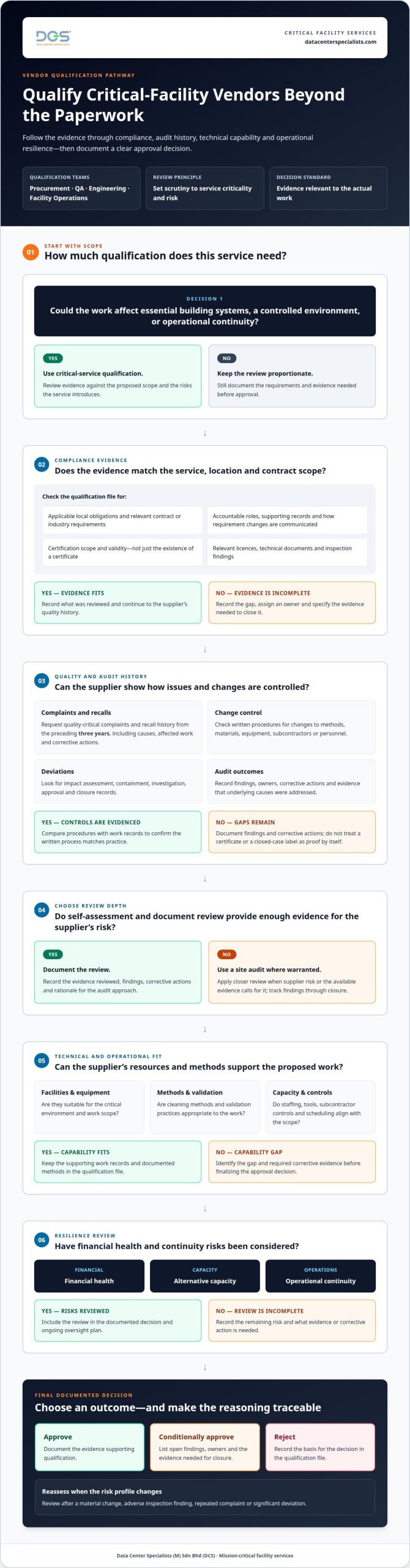
Start with a compliance register matched to the service, work location, and contract scope. For a Malaysian facility, separate local legal obligations from international requirements that apply through customer contracts, industry frameworks, or data-handling arrangements. Ask the supplier to identify applicable requirements, accountable roles, supporting records, and how changes are communicated. A general statement of compliance is not enough: the qualification file needs evidence relevant to the actual work.
Use certifications as evidence, not as a substitute for scope review. A supplier qualification checklist may ask whether the supplier holds ISO 9001 certification, but the certificate’s scope and validity still matter. For manufacturing-related suppliers, record the permits and licences required for their activities and confirm their validity. For service providers, request relevant regulatory or technical documentation and a summary of inspection findings, including corrective actions and closure evidence.
- Review recalls and complaints: Request recall and quality-critical complaint histories during the preceding three years, with causes, affected work, and corrective actions.
- Examine change control: Confirm written procedures cover changes to methods, materials, equipment, subcontractors, or personnel, and define how customer involvement is handled.
- Track deviations: Require records linking each deviation to its impact assessment, containment action, investigation, approval, and closure.
- Check audit outcomes: Record inspection dates, findings, responsible owners, and evidence that corrective actions addressed underlying causes.
These records show whether compliance is managed continuously or assembled only for approval. For example, a change to a cleaning method should trigger a documented review of its scope, equipment, and potential effects on the controlled environment. A complaint record should describe the issue and corrective response, not simply mark the case closed. Compare procedures with work records to spot gaps between the written method and what was done.
Address security and privacy according to the information the supplier can access. If a vendor handles customer data or connects to systems, specify permitted access, data handling, incident escalation, retention, and return or disposal arrangements in the contract. SOC 2 reports can support an IT security review; GDPR may be relevant where the processing relationship or applicable obligations make it relevant. Record the evidence reviewed, its coverage period, exceptions, and remediation status.
End with a documented decision: approve, conditionally approve, or reject. List open compliance findings, assign an owner to each corrective action, and specify the evidence needed to close it. Reassess when a material change, adverse inspection finding, repeated complaint, or significant deviation changes the supplier’s risk profile. This creates a traceable basis for approval and ongoing oversight without treating a certificate as proof of every operational control.
What Is a QA Vendor Evaluation Checklist and Who Needs One?
A QA vendor evaluation checklist is a documented way to assess a supplier’s quality systems, capacity, and technical capability before approval. A vendor qualification checklist for critical facility services applies that process to providers whose work can affect essential operations. Procurement, quality assurance, engineering, and facility operations teams use it to support qualification decisions and ongoing oversight.
Critical facility services include work that can affect essential building systems, controlled environments, or operational continuity. Examples include maintenance, commissioning, contamination control, airflow balancing, and other specialized services that support data center operations.
Use a shared checklist when several teams assess the same supplier. Procurement can document commercial and supply-chain requirements, engineering can review the technical scope, and quality assurance can evaluate procedures, records, and audit findings. This gives projects and facilities a consistent basis for approval.
Assess experience and technical competence using comparable work records, references, staff qualifications, and documented methods. Match each example to the proposed scope, then determine whether the supplier’s capacity, tools, and quality controls can support the work safely.
- Review the quality manual and procedures. Confirm that document control, corrective action, training, and change control have assigned owners.
- Map capacity to the service scope. Check staffing, equipment, subcontractor controls, and scheduling against the required work and supply-chain dependencies.
- Review audit evidence. Examine findings, corrective actions, closure records, and the rationale for any audit waived or required.
- Test performance monitoring. Identify service measures, reporting responsibilities, escalation routes, and records used to track recurring issues.
- Set periodic reassessment triggers. Define reviews after significant process changes, repeated defects, or material shifts in scope or capacity.
Service-level requirements should define the scope, deliverables, maintenance intervals, reporting, escalation, and response-time commitments. Set these according to facility needs and risk priorities, rather than applying one generic target to every service.
Use a quality agreement to document responsibilities before issuing purchase orders. Include acceptance criteria, records, change notification, deviation handling, corrective actions, audit rights, and inspection access. Clarify how subcontracted work is controlled and how performance issues are escalated.
For physical contamination-control work, align quality requirements with the environment, work method, and operational constraints. A structured qualification process can connect that scope to a data center preventive maintenance approach, with defined activities, responsibilities, and performance evidence.
Self-assessment surveys, documentation reviews, and site audits
Use a staged evaluation to test whether a supplier can consistently perform the defined scope. Begin with a self-assessment, review supporting documents, then decide whether the risk justifies a site audit. At each stage, record evidence, gaps, owners, and the approval decision.
For onboarding in Malaysia, collect the completed assessment, relevant quality procedures, current certifications, technical records, and details of subcontracted work. Review the documents, resolve material gaps, and record the approval status. Repeat the assessment periodically according to risk, performance, and changes to the service.
Design the survey to assess how the supplier controls its work, not just how well it completes a form. Request specific evidence of staff competence, equipment control, document revision, corrective action, and management review. For example, the supplier’s procedure should state who approves a method change and how affected work records are updated.
- Request supporting records. Review relevant procedures, training records, equipment-maintenance evidence, audit summaries, and technical documents that support the proposed scope.
- Check document consistency. Compare survey responses with procedures and work records; investigate conflicting revision dates, missing approvals, or unexplained gaps.
- Review subcontractor controls. Ask how subcontractors are selected, approved, monitored, and audited, and identify which tasks they perform.
- Record the audit decision. Document whether an audit is required or waived, with a rationale tied to supplier risk and available evidence.
Choose audit depth according to criticality, past performance, and supply-chain complexity. A second-party audit is conducted at the supplier’s facility by the purchasing organization. A third-party audit is conducted by an independent external auditor or certification body. Organizations may use either or both approaches, depending on risk and resources.
Prepare critical supplier audits by defining the scope, criteria, records, interview roles, and processes to observe. Trace a sample of work from planning through execution and review. If documentation raises concerns, a site visit can test whether actual practices match the documented quality management system. A targeted audit is also appropriate after specific concerns, such as failed tests or unresolved findings.
Set re-evaluation intervals through a risk-based procedure rather than applying one timetable to every supplier. A 2-3 year interval may be used by some organizations for recertification audits, but it is not a universal schedule; determine frequency based on risk assessment and performance history. An organization may require annual updates or assessments for critical suppliers covering product, process, facility, and regulatory matters. Record status as approved, conditionally approved, continued approval, or rejected, then reopen evaluation when evidence or performance changes.
Facilities, equipment, cleaning and validation
The supplier’s facility and equipment should suit the conditions and scope of the assigned work. Assess access controls, storage, work areas, equipment condition, and maintenance records. For a data center project, distinguish tools used in operational areas from equipment intended for construction or workshop environments. The supplier should explain how it prevents tools, materials, or residues from introducing contamination.
Review preventive maintenance records for equipment that affects service quality. Each record should identify the asset, maintenance performed, date, and any unresolved defect. Check how equipment is removed from service if its condition could affect the work. A damaged vacuum or a tool with overdue maintenance, for example, may compromise a cleaning method or cause the work to fall short of its acceptance criteria.
For physical contamination-control work, define the specific spaces and surfaces in scope. These may include raised floors, underfloor plenums, rack exteriors, overhead areas, or equipment zones. A supplier’s method should describe access controls, debris containment, suitable equipment, and protection of operational systems. Professional data center cleaning requires a method aligned with the environment, not a generic cleaning procedure.
- Review facility suitability. Confirm that storage and preparation areas protect tools and materials from contamination, damage, or mix-ups.
- Inspect equipment controls. Review identification, maintenance status, inspection records, and the process for reporting defects.
- Define acceptance criteria. Specify observable conditions, required records, and how incomplete or nonconforming work is handled.
- Assess validation capability. Request the supplier’s process-validation approach and documented procedures for validating processes.
Validation should demonstrate that a defined method can repeatedly meet its intended criteria under stated conditions. Review the protocol, scope, equipment, acceptance measures, results, deviations, and approvals. For example, a cleaning process may require a documented inspection method and agreed cleanliness criteria before work begins. A completed task sheet alone does not prove that the process was validated.
Link validation records to improvement actions. If a test or inspection fails, the supplier should document the affected area, investigate the cause, and record corrective measures before work resumes or closes. Changes to equipment, materials, or methods should prompt a review of validation impact. This traceable link between process, evidence, and corrective action helps determine whether the supplier remains capable as facility conditions or the work scope change.
Vendor financial and operational risk
Financial and operational risk can disrupt service even when technical work meets specifications. Riskmethods research found 79% of businesses lost 4% of revenue due to supply chain disruptions in the preceding three years. For a critical facility, a supplier’s financial distress can also affect staffing, maintenance, materials, and continuity of scheduled work.
Review the supplier’s turnover over the preceding three years, alongside available financial statements and explanations of material changes. Assess whether the business depends heavily on a single customer, location, or supply-chain route. Consider financial indicators together: turnover alone does not establish stability, but abrupt changes may warrant closer evaluation of capacity and continuity arrangements.
Ask whether alternative operating or manufacturing sites can support the service or materials under review. Establish what each alternative can provide, how work or supply would transfer, and which dependencies could delay the transfer. For a critical facility, a continuity plan should identify key personnel, essential equipment, records, suppliers, and communication routes. It should also explain how agreed activities will continue during a disruption.
Evaluate business continuity, emergency response, and disaster recovery by reviewing documented scenarios, decision-makers, escalation routes, recovery priorities, and evidence of exercises. Confirm how the supplier will notify the facility, protect ongoing work, and coordinate recovery with the customer. Define response expectations in the contract according to service criticality, operating arrangements, and the consequences of interruption.
- Assess concentration risk: Identify single-source materials, specialist equipment, subcontractors, and locations that could constrain delivery.
- Review public risk signals: Conduct proportionate reviews of media coverage and public records for relevant financial or operational red flags.
- Screen ownership and key personnel: Check relevant sanctions lists, blacklists, and politically exposed persons lists.
- Define continuity evidence: Record plans, exercise outcomes, recovery actions, and any unresolved dependencies.
Qualification continues after approval. Monitor supplier changes, delivery performance, financial indicators, and continuity-plan updates through scheduled reviews and reassessment when events warrant it. Businesses should regularly monitor suppliers and key personnel against sanctions lists and politically exposed person information. If a review identifies non-compliance or a continuity gap, establish a corrective action plan with an owner, evidence requirements, and closure criteria. Escalate repeated gaps through the supplier’s defined governance process.
Use a risk register to connect each finding with its operational consequence and treatment. For example, if a specialist subcontractor is the only source for a critical task, document the dependency and how it will be mitigated. This makes residual risk visible to procurement, finance, and facility operations, supporting informed approval and continuous oversight.
Data Center Specialists (M) Sdn Bhd (DCS): Mission Critical Facility Cleaning Services
Data Center Specialists (M) Sdn Bhd (DCS) provides mission-critical facility cleaning for data center environments where contamination control supports operational readiness. Its Professional Data Center ISO Cleaning Services cover physical cleaning requirements in equipment areas and other critical spaces.
Consider this service when a facility assessment identifies dust or particulate concerns, after construction activity, or when cleaning must account for operational constraints. Define the affected areas, cleaning method, access arrangements, and acceptance criteria so the work aligns with site procedures and facility priorities.
For related technical needs, DCS also provides Data Center Energy Assessment and Testing, Adjusting & Balancing (TAB). Contact Data Center Specialists (M) Sdn Bhd (DCS) to discuss your facility’s cleaning requirements and operational context.
Turn qualification findings into a practical next step
A qualification process is most useful when its findings shape a clear scope of work. Translate facility needs into defined deliverables, site requirements, acceptance criteria, and records that support operational decisions. This helps technical and procurement teams align expectations before work begins and gives future reviews a consistent reference.
For data center operators assessing environmental conditions or infrastructure performance, Data Center Specialists (M) Sdn Bhd (DCS) provides Professional Data Center ISO Cleaning Services, Data Center Energy Assessment, and Testing, Adjusting & Balancing (TAB). These services address distinct needs, from physical contamination control to energy use and system air balancing.
Use your vendor qualification checklist for critical facility services to connect the approved scope with the facility’s priorities and the evidence needed to assess completed work. A focused technical discussion can help clarify the appropriate service and assessment requirements. Contact Data Center Specialists (M) Sdn Bhd (DCS) to discuss your facility’s needs and determine a suitable next step.
Frequently Asked Questions
What is Vendor Due Diligence?
Vendor due diligence is a structured review of a supplier’s suitability, integrity, and ability to deliver agreed work. For a critical facility, this may include reviewing ownership, financial information, relevant qualifications, operational dependencies, and performance history. For example, before approving work in a live equipment area, procurement and facility teams can document who will perform it, what access is needed, and how identified risks will be managed.
What criteria should a critical facility vendor qualification checklist include?
Include criteria tied directly to the scope and potential operational impact. Assess technical competence, quality controls, relevant work experience, staffing and equipment capacity, subcontractor oversight, continuity arrangements, and performance reporting. For example, a supplier working near sensitive equipment should explain its access controls and work method, and how it records completed tasks. Define the evidence for each criterion and how unresolved gaps affect approval.
What certifications and licenses are required for critical facility service providers in Malaysia?
Requirements depend on the supplier’s activities, work scope, and applicable customer or regulatory conditions; there is no single certification that qualifies every critical facility provider. Ask which permits or licenses apply to the supplier’s work, then review their scope and validity. ISO 9001 can be included as a quality-system qualification question, but it should not replace assessment of technical competence or work-specific evidence.
What safety, health and environmental requirements apply to contractors at Malaysian critical facilities?
Set site-specific requirements before work begins, based on the task, facility procedures, and hazards present. The work package can document a task risk assessment, access authorization, required protective equipment, emergency communication, housekeeping, and controls for dust or debris. For work near operating equipment, define boundaries, permitted activities, and stop-work escalation. Include waste handling and incident reporting in the site coordination process.
What financial stability and insurance documents should critical facility vendors provide?
Request financial statements, a turnover history covering the preceding three years, and an explanation of material changes in business condition. Ask for current insurance certificates and relevant policy details, including insured activities, limits, exclusions, and expiry dates. Compare coverage with the contract scope and potential exposure instead of relying on a certificate alone. Record missing or unclear evidence as a condition for procurement review.
How should critical facility vendors be scored, compared and approved?
Use a common scorecard with criteria tied to the work, such as technical capability, quality controls, safety planning, capacity, continuity, and commercial suitability. Set scoring definitions before reviewing submissions so evaluators apply consistent standards. Keep mandatory requirements separate from comparative scores: a supplier that fails a critical prerequisite should not make up for it with strengths elsewhere. Record evidence, evaluator comments, unresolved risks, and the approval decision.
What are common risks and red flags when qualifying critical facility service vendors?
Warning signs include inconsistent records, unclear subcontracting, unexplained changes in financial condition, expired permits, unresolved audit findings, and reluctance to document work methods. A continuity plan with no responsible contact or one that depends on an unavailable resource also warrants closer review. Screen relevant public records and sanctions information, then document findings and follow-up actions. Treat repeated gaps as a change in supplier risk, not merely an administrative issue.