

The obvious choice between hot aisle and cold aisle containment may not be the right one for your facility. For operators comparing hot aisle cold aisle containment Malaysia options, the decision depends less on a universal efficiency claim and more on how each approach fits the existing racks, cooling system and operating practices.
Both strategies separate supply air from warmer air returning from IT equipment, but they enclose different aisles and can affect access, airflow paths and system operation in different ways. A clear answer can be difficult when a project must work within an operating data center rather than an idealised design.
This article explains how hot aisle and cold aisle containment manage airflow, then compares the design and operational trade-offs that should guide a decision. It also outlines what to check, from rack layout and cooling configuration to temperature data and operating requirements, before discussing options with a specialist. The goal is a site-specific assessment, not an assumption that one approach is always better.
Key Takeaways
- Containment helps separate cooling supply air from warmer equipment exhaust, supporting more controlled airflow through the data hall.
- Compare hot aisle and cold aisle containment by considering the enclosed air stream, rack arrangement, equipment access and cooling-system integration.
- Use a site-specific review to assess hot aisle cold aisle containment Malaysia options rather than assuming one approach will suit every facility.
- Before selecting a design, gather rack orientation, cooling-system details, airflow observations and operational constraints for assessment.
- Evaluate DCS Smart Modular Containment only after the facility’s layout, cooling, access and operating requirements are understood.
Why hot aisle and cold aisle containment matter in Malaysian data centers
Containment manages the boundary between cooling supply air and warmer exhaust from IT equipment. Without a defined separation, supply air can mix with return air before reaching equipment, while hot exhaust may recirculate towards server intakes. This makes cooling delivery and temperature management harder to assess, particularly when airflow paths are obstructed or inconsistent.
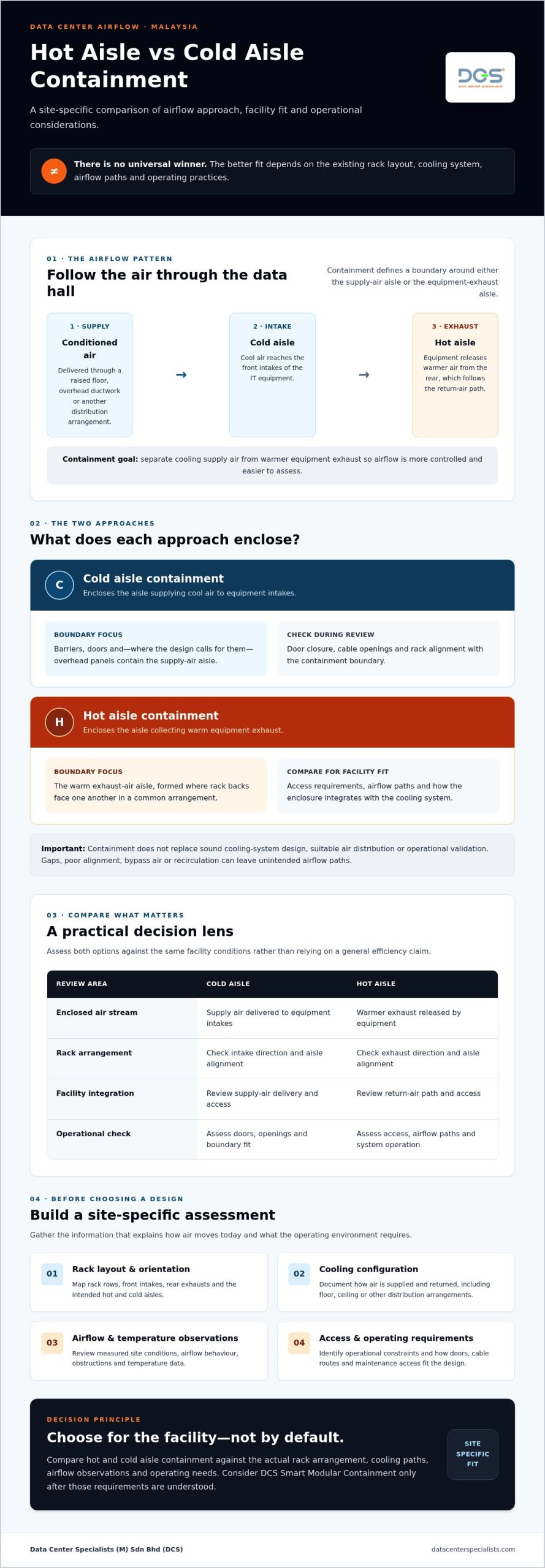
Cold aisle containment encloses the aisle supplying cool air to equipment intakes; hot aisle containment encloses the aisle collecting warm equipment exhaust. Both approaches support airflow management, but neither replaces sound cooling-system design, suitable air distribution or operational validation. The right choice for hot aisle cold aisle containment Malaysia depends on the facility’s actual layout and cooling conditions.
For a visual introduction to data center infrastructure, watch this overview of power flow from the utility grid to the server rack:
How hot and cold aisles form in a rack layout
In a common arrangement, racks face front-to-front across a cold aisle. Equipment intakes draw air from that aisle, while the rack rears release warmer exhaust into the hot aisle, often formed where rack backs face one another. This orientation establishes intended supply and return paths, but does not guarantee that air follows them consistently. Rack design, blanking, floor or ceiling supply, return-air arrangements and other facility details all affect actual airflow.
Why containment is considered in Malaysia
Malaysia is the service context, not a single set of cooling conditions. Facilities can differ in building design, cooling-system configuration, rack loading, operating requirements and how air is supplied and returned. Avoid choosing containment based only on a general assumption about the national climate. Assess measured site conditions, airflow behaviour and equipment requirements instead. For foundational context, see this overview of data center environmental control.
Containment should be evaluated alongside the wider cooling arrangement. An enclosure cannot correct every airflow imbalance or compensate for unsuitable system design. Review the facility before selecting a solution, and consider whether data center containment solutions align with its rack layout, cooling paths and operating practices.
How hot aisle and cold aisle containment control data center airflow
Airflow starts at the cooling equipment, which supplies conditioned air to the data hall. Depending on the system, that air reaches the cold aisle through a raised floor, overhead ductwork or another distribution arrangement. Servers draw it through their front intakes, and their fans move it across internal components before discharging warmer exhaust from the rear. The exhaust then enters the hot aisle and follows the facility’s return-air path towards the cooling equipment.
Containment creates a defined boundary around either the supply-air aisle or the exhaust-air aisle, making the intended airflow pattern easier to assess. Separation does not guarantee that bypass air or recirculation will disappear. For an overview of the basic hot and cold aisles arrangement, consider how rack intake and exhaust directions establish separate air paths.
How cold aisle containment encloses supply air
Cold aisle containment uses barriers, doors and, where the design calls for them, overhead panels to enclose the aisle receiving conditioned supply air. The objective is to deliver that air to rack inlets rather than let it disperse prematurely into the wider room. Check that doors close as intended, cable openings are managed and racks align with the containment boundary. Gaps or poor alignment can create unintended airflow paths.
For example, an opening around a cable route may allow supply air to escape, while an unsealed rack position can leave a gap in the aisle boundary. Inspect these conditions rather than assuming their impact: the effect depends on system pressure, airflow and configuration. Cold aisle containment must also suit how staff access equipment and move through the data hall.
How hot aisle containment captures equipment exhaust
Hot aisle containment encloses the rack rear aisle so warmer exhaust can be directed towards the return-air route. Depending on the cooling-system configuration, that route may use a ceiling return, ductwork or another designed path. Review how the enclosure connects to the return arrangement. Capturing exhaust in an aisle is useful only if the overall system can handle its routing.
Access doors, service clearances, cable pathways and the facility’s fire strategy all require project review before installation. Confirm how operators will safely reach equipment and how proposed barriers interact with existing building and cooling systems. A site assessment should also investigate potential bypass air, where supply air avoids equipment intakes, and recirculation, where warm exhaust reaches them. Neither condition is inevitable, so use measurements and observation to establish whether either is occurring.
For facilities assessing hot aisle cold aisle containment Malaysia options, connect the enclosure design to airflow assessment and cooling-system operation. Data Center Specialists’ data center containment solutions can be considered as part of that site-specific review.
Hot aisle vs cold aisle containment: compare fit, operation, and trade-offs
Compare the options by asking which air stream the facility needs to control and how the enclosure will interact with the existing room. Cold aisle containment encloses the supply-air zone at rack intakes; hot aisle containment encloses the exhaust-air zone to guide warmer air towards its return path. Neither approach is universally better. The suitable arrangement depends on rack orientation, cooling delivery, return-air design and how teams operate the space.
| Consideration | Cold aisle containment | Hot aisle containment |
|---|---|---|
| Enclosed air stream | Cool supply air at equipment intakes | Warmer exhaust air behind equipment |
| Layout fit | Assess rack fronts, aisle boundaries and supply-air delivery | Assess rack rears and the route from the enclosed aisle to return air |
| Access | Check door locations, aisle use and routine service access | Check access to rack rears and any constraints on enclosed work areas |
| Integration questions | Can the cooling system deliver air effectively within the enclosure? | Can the return-air arrangement accommodate captured exhaust? |
Containment is an airflow-management measure, not a guaranteed energy-saving project or a stand-alone remedy for hotspots. Results depend on the whole cooling system and how air moves through the room. The World Bank’s guidance on sustainable data center airflow management includes aisle containment among relevant practices, but each facility still needs to assess its own conditions. Separate general design intent from measured outcomes: verify temperature patterns, airflow behaviour and cooling-system operation before attributing a change to containment.
When a cold aisle enclosure may fit
A cold aisle design may warrant review where the priority is controlling supply air near equipment intakes. Confirm that racks face the intended aisle, cooling air reaches it as designed, and doors or barriers will not conflict with access and daily operating routines. A rack-layout sketch is not enough on its own. Validate actual supply paths and constraints before selecting this arrangement.
When a hot aisle enclosure may fit
A hot aisle design may suit a facility focused on collecting and routing exhaust air. Review the return-air path, cooling-system compatibility, rack access and any operational or fire-strategy constraints with the relevant project team. For hot aisle cold aisle containment Malaysia decisions, compare these site-specific factors rather than relying on broad efficiency claims. A professional containment assessment can help establish which requirements need validation.
How to assess containment requirements for a Malaysian data center
Choose a containment arrangement only after checking how the facility currently moves and manages air. A structured assessment helps distinguish a layout issue from a cooling-system or operational constraint. For hot aisle cold aisle containment Malaysia projects, document existing conditions first, then define how the proposed arrangement will be evaluated.
- Review the layout. Map rack locations and orientation, aisle boundaries, blanking practices, cable openings and planned changes to the room.
- Document the cooling system. Record how supply air reaches equipment and how warmer air returns. Gather available system information and environmental monitoring data.
- Observe airflow concerns. Note reported or observed hotspots, possible bypass paths, recirculation concerns and areas where air distribution may be uneven. Treat these as items to investigate, not assumed causes.
- Record operating constraints. Identify routine equipment access, maintenance activities, safety requirements and change-management processes that could affect installation or ongoing use.
- Set validation criteria. Agree on assessment objectives and suitable measurements before implementation. Compare the proposed arrangement with documented baseline conditions and review results with the facility team.
What facility evidence should operators collect?
Use current floor plans where available, and verify them against the installed rack arrangement. Record aisle dimensions and boundaries, rack orientation, blanking practices and known airflow concerns. Collect relevant cooling-system details and available temperature or environmental monitoring information. Include access and maintenance requirements, since these can affect both enclosure design and long-term use.
How should teams validate a proposed arrangement?
Define what the assessment needs to establish, such as whether supply air reaches equipment as intended or whether return-air routing needs review. Select measurements that correspond to those questions. If air distribution requires investigation, consider Testing, Adjusting & Balancing (TAB). Cleanroom Performance Testing (CPT) may also be relevant when assessing environmental performance against the facility’s requirements.
Connect the review to wider facility evidence where appropriate. A data center energy assessment can help place cooling and energy observations in facility context. For installation decisions, confirm compatibility with the actual layout, equipment and operating requirements rather than relying on generic assumptions.
Facility stakeholders should review the findings and agree on how operational impacts will be managed before committing to a design. Data Center Specialists offers data center energy assessments and TAB as part of its technical assessment services.
Explore modular containment options with DCS after assessing facility fit
Once the facility’s layout, cooling arrangement and operating requirements are understood, DCS Smart Modular Containment can be considered for further evaluation. Treat system selection as a result of the assessment, not a starting assumption. The proposed arrangement needs to suit the actual rack configuration, supply and return-air paths, equipment access and maintenance practices.
For operators comparing hot aisle cold aisle containment Malaysia solutions, translate site findings into clear design requirements. Share the evidence gathered during assessment and ask how the proposed configuration will address those specific conditions. Confirm compatibility, dimensions and integration details against the individual facility rather than assuming they will suit every site.
What to discuss with a containment provider
Prepare current facility layout information, rack configuration, cooling-system details, known airflow concerns and operational constraints. Then review practical requirements with the provider:
- How will the proposed design accommodate equipment access and routine maintenance?
- How will it integrate with existing cooling and return-air arrangements?
- What assumptions have been made about rack alignment, openings and future changes?
- Which measurements or other validation criteria will be used to assess the arrangement?
Request clear answers and documented assumptions. This helps facility, engineering and operations teams understand what the proposal addresses, what remains subject to verification and how changes may affect day-to-day work. Treat projected benefits as unproven until suitable site evidence supports them.
When to seek a specialist assessment
Seek a closer review if airflow concerns persist after routine operational adjustments, or before significant changes to rack layout or cooling infrastructure. Early technical discussion can help identify constraints that may affect design, access, maintenance or integration. It also gives the project team an opportunity to define assessment objectives before selecting an arrangement.
Data Center Specialists provides containment solutions, including DCS Smart Modular Containment. Its technical services also include data center energy assessments, TAB and CPT. These services can inform a review of facility requirements and the proposed approach, without presuming that one containment method or performance outcome will suit every site.
Make containment decisions with site evidence
Hot aisle and cold aisle containment both aim to separate supply air from equipment exhaust, but the right fit depends on the facility’s rack layout, cooling configuration, access needs and operating practices. For hot aisle cold aisle containment Malaysia projects, assess airflow and cooling conditions before selecting an arrangement. Containment can support airflow management, but it does not guarantee energy savings or resolve every temperature issue on its own.
DCS offers DCS Smart Modular Containment alongside data center energy assessment, Testing, Adjusting & Balancing (TAB) and Cleanroom Performance Testing (CPT). These capabilities can inform a technical review of facility requirements and a proposed approach, without assuming a particular performance outcome.
Bring your layout information, rack configuration, cooling-system details and operational constraints to the discussion. Discuss your data center containment requirements with DCS to explore options based on your facility’s needs.
Frequently Asked Questions
What is hot aisle and cold aisle containment?
Hot aisle and cold aisle containment are methods of separating cooling supply air from warmer air exhausted by IT equipment. Cold aisle containment encloses the aisle supplying air to equipment intakes; hot aisle containment encloses the aisle receiving equipment exhaust. The intended airflow path depends on the facility’s design and cooling arrangement. Review rack orientation, supply-air delivery and return-air routing before deciding which approach to assess.
Which is better, hot aisle containment or cold aisle containment?
Neither approach is automatically better for every data center. The suitable choice depends on rack orientation, cooling-system design, return-air paths, access requirements and operating constraints. Compare those factors using site evidence rather than general claims. A technical assessment can help identify which arrangement fits the facility and what should be validated after implementation, including whether intended airflow paths are being achieved.
Does aisle containment reduce data center energy consumption?
Aisle containment can support more controlled airflow, but it does not guarantee a specific reduction in energy use. Outcomes depend on the existing cooling configuration, airflow balance, rack layout and operating conditions. Establish baseline conditions and define suitable validation measures before attributing any change to containment. Generic savings figures may not reflect a particular site, so assess actual facility data instead of relying on broad estimates.
Can hot aisle or cold aisle containment be installed in an operating data center?
It may be possible, but feasibility depends on the facility layout, equipment access, cooling arrangement, implementation sequence and operational risk controls. Work in a live environment needs careful planning to protect service continuity and maintain safe access. Before committing to a design or schedule, have facility specialists review operational constraints, change procedures, installation requirements and how the proposed arrangement will be validated.
How do I choose between hot aisle and cold aisle containment in Malaysia?
Start with the facility’s rack arrangement, cooling-system design, airflow observations, monitoring information and operating requirements. For hot aisle cold aisle containment Malaysia options, assess site conditions rather than assuming one solution suits every facility. Compare access, maintenance needs and return-air routing, then document assumptions and measurements for evaluating the proposed arrangement. This helps teams base the decision on facility evidence.
What information should I prepare before requesting a containment assessment?
Gather available floor layouts, rack locations and orientation, cooling-system details, known airflow concerns, environmental monitoring data and operational constraints. Include access and maintenance requirements, along with any planned infrastructure changes. You do not need to choose a containment type in advance. This information helps a specialist understand the current arrangement, identify gaps in the available evidence and discuss appropriate next steps without presuming a particular design or outcome.