
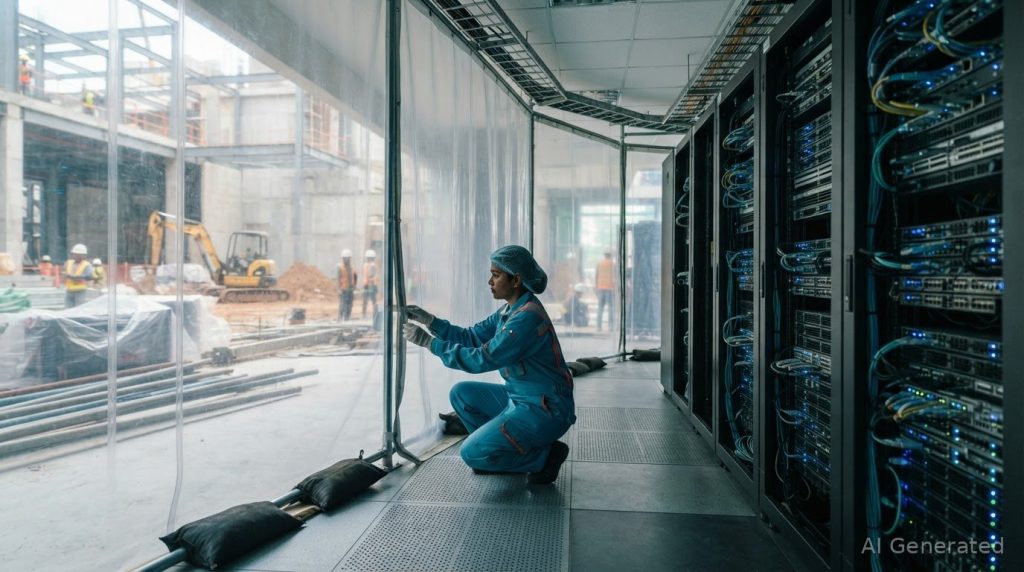
Nearby construction can put mission-critical equipment at risk even when work stays outside the facility. To understand how to protect equipment during nearby construction, coordinate work boundaries and access, assess exposure to falling objects, scaffold activity, utility lines, ground disturbance, dust and vibration, then apply controls suited to each hazard.
Visible threats such as debris or vehicle movements are only part of the risk. Hazards can also travel through shared ground, service routes and air pathways. A protection plan should account for equipment location, operating sensitivity and the construction activity taking place nearby.
This guide explains how to identify the main hazards and reduce exposure through practical coordination, physical separation, monitoring and inspection. It also covers when contamination or airflow assessments can help data center teams in Malaysia protect operational continuity during nearby construction.
Key Takeaways
- Map nearby work activities against equipment locations and access routes to identify exposure to falling objects, moving vehicles, dust and vibration.
- Keep equipment and sensitive areas separated from construction traffic and perimeter hazards wherever site layout allows.
- Assess scaffolds, overhead work and utility lines for risks that could affect equipment or safe access, and coordinate controls before work begins.
- Account for disturbed or unstable ground when planning equipment placement, deliveries and construction access around the facility.
- After construction activity, consider specialist rack and equipment cleaning when dust or debris may have entered operational areas.
1. Construction-site hazards including falling and moving objects
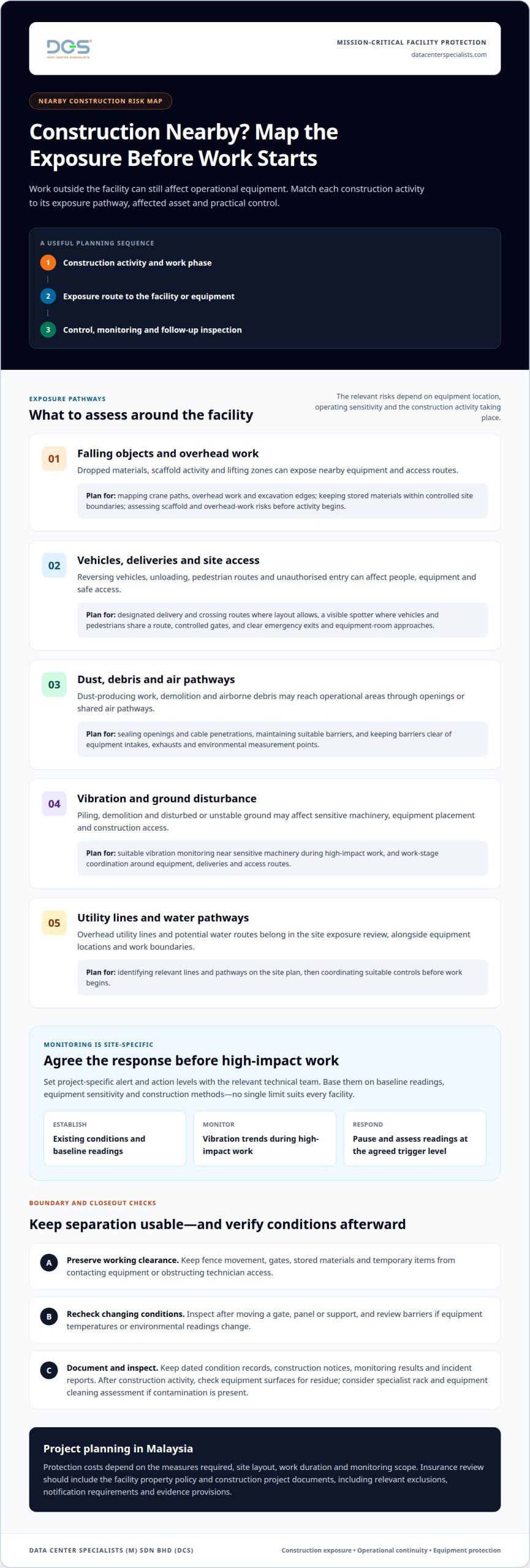
A construction site can expose nearby equipment to dropped materials, reversing vehicles, airborne debris and unauthorised access. Start with a site plan that marks the facility boundary, equipment rooms, loading points, crane paths, excavation edges and pedestrian routes. Compare the layout with each work phase, since delivery movements and lifting zones may change as construction progresses.
Use physical boundaries to separate construction activity from operational areas. Fencing or hoarding should define where workers, vehicles and stored materials can enter, while gates should remain controlled rather than propped open. Keep materials within the site perimeter and away from fence lines, where they could topple, roll or be reached from outside.
Plan access routes before work begins. Where the layout allows, separate delivery traffic from staff entrances. Identify turning, reversing and unloading areas that face facility walls or service access points. Use a designated crossing and visible spotter where vehicles and pedestrians share a route. Keep emergency exits and equipment-room approaches clear throughout every work phase.
Prevent unauthorised access with controlled gates, visitor sign-in, site induction and escort procedures for restricted work areas. Secure the site when work stops, and keep tools and mobile equipment inside controlled zones. CCTV covering entrances, storage areas and boundary approaches can help record movement and reveal access-control gaps. Pair monitoring with a defined response process.
Assess risks by mapping dust-producing work, demolition or piling, water pathways and debris exposure against equipment locations. Record existing conditions, then use suitable vibration monitoring near sensitive machinery during high-impact work. Set project-specific alert and action levels with the relevant technical team, based on baseline readings, equipment sensitivity and construction methods. No single limit suits every facility.
Protect electronics from construction dust by sealing openings and cable penetrations, maintaining suitable barriers, and controlling access between work zones and operational rooms. Do not direct ordinary site airflow toward racks or rely on loose covers that obstruct ventilation. For piling or demolition, coordinate work stages, monitor vibration trends and pause to assess any reading that reaches the agreed trigger level.
In Malaysia, protection costs depend on the required measures, site layout, work duration and monitoring scope. Obtain a project-specific quotation before committing expenditure. For potential damage, review the facility’s property policy and the construction project’s insurance documents, including relevant exclusions, notification requirements and evidence provisions. Keep dated condition records, construction notices, monitoring results and incident reports to support any later assessment.
2. Clear space between fences and equipment
A perimeter fence should not become an extension of an equipment room. Leave clear space between the fence and nearby assets so routine fence movement, inspection or maintenance does not bring workers or materials into contact with sensitive equipment. Assess the arrangement at each location, including cabinets, external sensors, exposed cabling and equipment enclosures.
Use an equipment layout to identify the service side of each asset. A technician may need to open a cabinet, reach a connection point or remove a panel without contacting the fence. Keep this working area unobstructed, and allow space to carry tools or replacement components safely. A narrow gap that looks clear on a drawing may not work during maintenance.
Check the separation from more than one viewpoint. Walk along the boundary beside the equipment, then inspect from the equipment side for protrusions, loose fence sections or sharp edges facing the asset. Record contact risks and arrange suitable adjustments before nearby work changes the surrounding conditions.
Pay attention to how the fence is supported. Temporary panels, posts and gates can shift when opened, handled or exposed to nearby activity. Keep equipment outside their movement paths, and ensure gates do not swing into enclosures or block technicians’ working positions. Recheck the arrangement after moving a gate, panel or support.
Keep the separation usable throughout the work period, not just during setup. Mark the clear area on site drawings and prevent temporary items from occupying it. For example, a cable reel beside an enclosure can make inspection difficult and force workers into awkward positions. Remove obstructions and restore access promptly.
Consider airflow and environmental monitoring when placing temporary barriers near equipment. A screen can change the airflow reaching an intake, while dust settling on a sensor can affect its condition or readings. Keep barriers clear of intakes, exhausts and measurement points, and review the arrangement if equipment temperatures or environmental readings change.
After construction activity, examine the gap and equipment surfaces for residue that may have crossed the boundary. If contamination is present on racks or equipment, a specialist data center rack and equipment cleaning assessment can address the affected mission-critical areas. Document observed locations so follow-up work can focus on actual exposure.
Construction site managers should leave space between perimeter fences and equipment to deter thieves. Treat the separation as a deliberate part of the site layout, not as space to fill as work progresses. Check whether equipment is so close to the fence that the intended gap is lost. Keep the area clear as temporary items arrive, and review it whenever the arrangement changes. A consistent gap supports perimeter security while keeping the equipment area distinct from the fence line. Consider this when positioning equipment and inspecting the boundary during site work.
3. Falling objects and scaffold protection
Scaffold work beside a data center needs controls suited to the platform, task and exposed area. Before erection, identify work positions, material transfer points and equipment below or beside the scaffold. This helps define where falling-object protection is needed and which areas must stay inaccessible during overhead work.
Toe-boards, brick guards and netting can help stop tools or materials falling through scaffold edges. Select and position them for the scaffold configuration and materials being handled. Keep platforms orderly and loose items away from open edges. Maintain protection while workers move materials and during scaffold alteration or dismantling.
For sensitive equipment, Data Center Specialists (M) Sdn Bhd (DCS) recommends first considering whether work can be moved away from the exposed area or the equipment safely relocated. If neither is practical, use a suitable rigid barrier or purpose-designed overhead protection. It must suit the expected exposure, be securely supported and avoid creating hazards for workers or obstructing equipment operation.
Protective covers serve a different purpose. A fitted cover can limit dust or light debris on an inactive surface, but it is not a shield against falling tools or construction materials. On operating equipment, assess ventilation and access before using a cover. One that blocks an intake or exhaust can interfere with cooling, while an unsecured cover may shift during nearby work.
Where the layout allows, plan material handling so scaffold workers do not pass loads over sensitive equipment. Define a transfer route and staging position, and inform the facility team when materials move above or beside operational areas. Stop work if a load, barrier or scaffold component moves outside the agreed work zone.
Schedule checks at key work stages: before overhead activity starts, after scaffold changes and before the area returns to normal access. Inspect netting for tears, toe-boards for displacement and platforms for loose materials. Record defects and have the construction supervisor correct them before exposed work resumes.
After overhead work ends, assess the equipment area. Look for residue on rack tops, cable trays and nearby surfaces, including areas hidden from floor level. Remove temporary protection carefully so trapped dust does not fall into equipment openings. Reviewing conditions after each work phase helps identify contamination or damage while the likely source is clear.
Construction projects should also prevent objects from falling beyond the site boundary. Consider the boundary, as well as areas below and beside the scaffold, when planning overhead work.
Fall prevention extends beyond scaffold platforms. Excavations, manholes, stairwells and open floor edges should have barriers or covers to prevent people falling into or from them. Secure access points to help keep children away from construction hazards. Include openings and access points in work-area controls.
4. Overhead utility lines and poor ground conditions
Overhead utility lines can be endangered by crane booms, elevated platforms, long materials and vehicle bodies. Before work starts, compare line locations with the full movement envelope of plant and loads, not just their parked positions. Include delivery routes and any area where equipment may be raised, tilted or rotated.
Before work approaches a line, have the construction supervisor coordinate with the relevant utility operator. Confirm the line’s status and agree on work controls with competent personnel. Treat every line as energised unless the responsible utility authority establishes otherwise. Do not rely on visual appearance, warning signs alone or an operator’s estimate of clearance.
Put the agreed controls into the work plan. Mark restricted operating areas where operators can see them, brief workers before the task and assign a spotter if the operator cannot continuously see the line and equipment movement. Stop work if visibility is lost, the load shifts or the planned position changes. Restart only after the supervisor reviews the revised arrangement.
Excavation and piling also require attention to underground services and facility connections. Before disturbing the ground, review available service drawings and identify known cable routes, drainage lines and other buried infrastructure. Mark the planned work area, agree how to excavate near identified services, and stop for assessment if workers encounter an unexpected duct, cable or service marker.
Assess ground suitability for the actual plant and task. A surface that supports a delivery vehicle may not safely support a crane or concentrated outrigger load. Review pavement condition, slopes, soft areas, recent backfill, drainage and signs of settlement. The construction team should confirm suitable support at every operating position before placing heavy equipment.
Heavy rainfall in Malaysia can quickly change exposed or disturbed ground. After rain, inspect for pooling, erosion, softened surfaces and water running toward building entrances or service penetrations. Reassess routes and equipment positions when conditions change. Do not assume the previous day’s ground assessment still applies.
Track changes near the facility with dated observations at agreed locations. Record new cracks, uneven surfaces, water ingress or changes around doors and service entries, then compare them with the pre-work condition record. Escalate changes for technical assessment rather than automatically attributing them to construction. This helps distinguish normal site variation from potential effects on the building or equipment.
5. Pre-planning and safe work practices
Before construction begins, establish one coordinated work plan for facility operations and construction workers. Map affected equipment, access routes, planned lifts, excavation zones and work phases. Address how to protect equipment during nearby construction by assigning named contacts for operational approval, site coordination and incident escalation. Distribute the current plan to workers and authorised visitors, then provide a site induction covering boundaries, restricted areas and reporting procedures.
A pre-construction condition survey provides a baseline for comparison. Record equipment identifiers, rack locations, operating status, visible damage, unusual noise, alarms and nearby surface conditions. Take dated photographs from consistent viewpoints, and document existing dust, water ingress, vibration readings or structural marks where relevant. Include cable routes, equipment clearances and access points that construction may affect.
Make the baseline specific to the exposure. For example, record existing floor cracks near a proposed excavation or note the normal operating condition of equipment beside planned piling. Agree how observations will be repeated during work and who will review changes. Dated records help distinguish pre-existing conditions from changes noticed after construction begins.
Move equipment only after the facility team evaluates operational impact, lifting requirements, route capacity, clearances and reconnection needs. Use an approved handling plan, protect cables and connections, and record the asset’s destination and status. Coordinate any equipment isolation or shutdown with facility operations, following the facility’s approved procedures. Do not interrupt live services solely for contractor convenience.
Coordinate construction work involving hazardous energy with facility operations and follow the facility’s approved isolation procedures. Confirm responsibilities and required approvals before work begins.
Set hold points before high-impact or high-risk tasks. The construction supervisor should notify facility operations before piling, demolition, lifting above sensitive areas or changing vehicle routes. At each hold point, review the work location, active protection, equipment status and communication method. Workers should stop and report changed conditions rather than continue under an outdated plan.
Keep a shared work log for construction notices, survey updates, alarms, incidents and agreed actions. Record the date, location, activity and responsible contact for each entry. After a work phase, compare observations with the original condition survey and close outstanding actions before the next phase proceeds. This gives facility teams a traceable basis for decisions and keeps the protection plan aligned with actual site conditions, a practical part of how to protect equipment during nearby construction.
Data Center Specialists (M) Sdn Bhd (DCS): Data Center Rack & Equipment Cleaning
Data Center Specialists (M) Sdn Bhd (DCS) provides Data Center Rack & Equipment Cleaning for facilities where nearby construction may have introduced dust or debris into equipment areas. Use this service when construction is complete or concerns about contamination around racks and equipment remain despite boundary controls.
Cleaning in a mission-critical environment requires attention to equipment surfaces and surrounding areas, not routine janitorial methods. Where construction residue affects wider operational spaces, Data Center Post-Construction Cleaning and Professional Data Center ISO Cleaning Services may also be relevant. The appropriate scope depends on the affected areas and observed contamination.
Contact Data Center Specialists (M) Sdn Bhd (DCS) to discuss rack and equipment cleaning for your facility.
Carry the protection plan into ongoing operations
Nearby construction can change conditions around a live facility, so treat protection as an operational process rather than a one-time setup. Connect the construction work plan to facility reviews and update controls when work locations or methods change. This makes decisions traceable and helps teams respond consistently to newly observed contamination or equipment concerns.
Knowing how to protect equipment during nearby construction also means deciding what technical support is appropriate after work ends. If construction dust affects racks or equipment areas, Data Center Specialists (M) Sdn Bhd (DCS) provides Data Center Rack & Equipment Cleaning and Professional Data Center ISO Cleaning Services. For wider facility questions, its Data Center Energy Assessment and Testing, Adjusting & Balancing (TAB) services can address relevant energy or system-balancing needs.
Discuss the facility’s requirements and affected areas with Data Center Specialists (M) Sdn Bhd (DCS). A clear next step can help your team move from construction controls to a considered operational response.
Frequently Asked Questions
What Are the Main Risks in Construction Environments?
The main risks are impact, contamination, vibration, utility contact, water intrusion and restricted access. Their effects depend on the work method and equipment exposed. For example, demolition beside a live control panel may combine airborne dust and vibration, while deliveries can threaten external cabling or access points. Assess each activity against the facility’s operating dependencies, then prioritise equipment whose failure could interrupt critical services.
How to protect equipment from construction debris, impacts, and falling objects?
Combine separation, secure storage and equipment-specific protection. Move portable test instruments, spare modules and removable accessories into a controlled room before nearby work starts. Secure exposed cable trays and external sensors in line with facility procedures, and keep loose items off racks and equipment tops. After debris exposure, document affected locations and inspect external connections and ventilation openings before returning disturbed equipment to normal operation.