
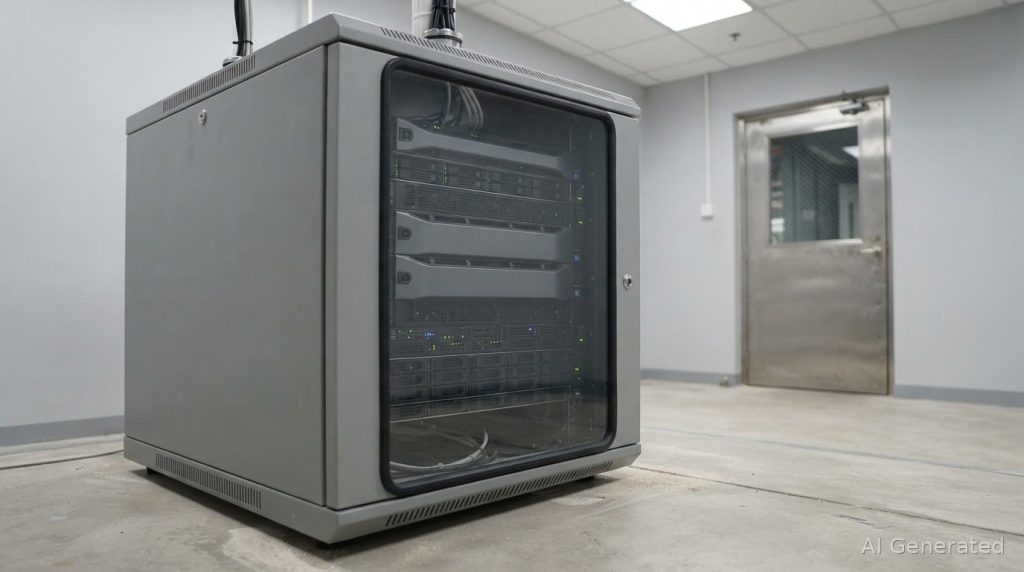
Data center infrastructure must be maintained to account for dust, liquid exposure, heat, humidity and vibration while keeping systems supportable and operational. IEC 60529 classifies enclosure protection against water and dust, according to the International Electrotechnical Commission.
These conditions affect more than equipment lifespan. Dust can impede cooling, moisture can contribute to corrosion, and vibration can loosen connections over time. In Malaysia, data center operators need maintenance practices tailored to each facility rather than a one-size-fits-all schedule.
This article explains how environmental stress, contamination and management complexity shape maintenance priorities, and how failures can disrupt operations. It also covers the role of suitable enclosures, inspections, preventive maintenance and facility assessments in reducing avoidable risks. The aim is to help data center and critical facility teams make informed decisions about infrastructure upkeep, from equipment exposure to cooling performance and continuity planning.
Key Takeaways
- Match rack and equipment protection to the dust and moisture conditions in each data center area.
- Account for heat, humidity, vibration and temperature changes when assessing data center equipment suitability and maintenance needs.
- Keep asset information, preventive maintenance procedures and facility-team responsibilities aligned to support reliable data center operations.
- Assess downtime by its impact on data center operations, not only by the cost of replacing failed equipment.
- Use facility assessments, contamination control and cooling-performance reviews to identify infrastructure issues that routine checks may miss.
What makes data center computing environments different?
Data center equipment operates in environments where particulate contamination, temperature, humidity and airflow must be managed to support reliable operation. Maintaining IT infrastructure in a data center means accounting for how these conditions affect equipment, cooling paths and facility operations. For Malaysian facilities, the practical priority is to match protection and maintenance to conditions in each area, from data halls to electrical and mechanical spaces.
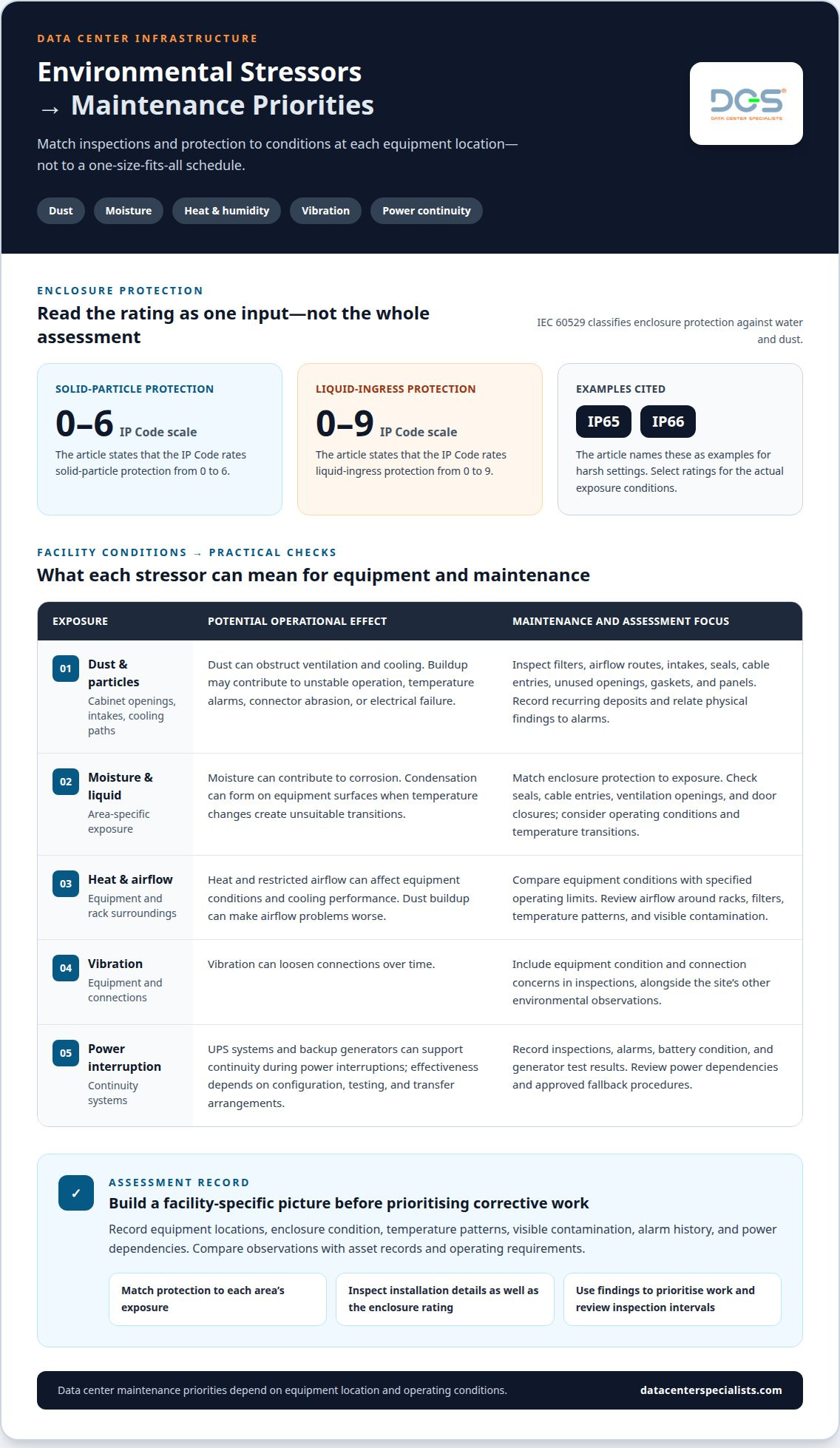
Dust can obstruct ventilation, while humidity and temperature changes can produce condensation on equipment surfaces. Enclosure ratings help describe some aspects of environmental protection, but installation details and operating conditions matter too. IEC 60529 classifies and rates enclosure protection against water and dust, according to the International Electrotechnical Commission.
Dust, Humidity, and Temperature Protection
An enclosure’s protection rating describes how well its housing limits exposure to particles and water during operation. Openings, cable entries and seals matter because they can undermine that protection after installation.
Treat the rating as one input, not a substitute for inspecting the installation. A cabinet in a mechanical area faces different humidity and contamination risks from a rack in a controlled data hall. Check seals, cable entries, ventilation openings and door closures for possible contaminant entry points. Temperature transitions matter too: equipment moved between cooler and warmer areas can encounter condensation, so stable operating conditions and suitable transitions help protect connectors and circuit boards.
For Malaysian data centers, workplace safety and electrical requirements depend on the equipment, installation and site conditions. The European Union identifies ATEX Directive 2014/34/EU as the directive associated with ATEX equipment certification, but it is an EU directive, not a blanket Malaysian requirement.
Cooling, Power, and Preventive Maintenance
Cooling and preventive maintenance help manage heat, airflow, power quality and developing faults. In areas where dust may enter, inspect filters and airflow routes for particle buildup that could obstruct cooling. Compare equipment conditions with specified operating limits and review airflow around racks for potential cooling issues.
Protect data center equipment from contamination, humidity and temperature swings while keeping inspection access safe. UPS systems and backup generators can support continuity during power interruptions, but their effectiveness depends on configuration, testing and transfer arrangements. A maintenance plan should record inspections, alarms, battery condition and generator test results. A disciplined approach to maintaining data center IT infrastructure ties these checks to operational needs.
Protection also depends on independent safeguards. Where practical, separate critical facility functions and define how systems should respond if a network connection, sensor or primary controller fails. Safe degraded operation means the system can move to a controlled state instead of continuing with unreliable inputs. Document the fallback and test it under an approved operating procedure.
During an assessment, record equipment locations, enclosure condition, temperature patterns, visible contamination, alarm history and power dependencies. Compare these observations with asset records and operating requirements. For teams maintaining data center IT infrastructure, this evidence helps prioritise corrective work, revise inspection intervals and identify where environmental controls or system design need further attention.
Sealing against dust and liquid ingress
Ingress protection depends on the particles, water exposure and cleaning methods at each equipment location. Choose an enclosure rating suited to those conditions, then preserve its protection through installation and maintenance.
Dust Infiltration and IT Outages
Fine dust can enter through cabinet openings, cable routes and cooling paths, then accumulate on components. Buildup can restrict airflow, abrade connectors or create conductive paths that contribute to electrical failure. A dusty production area and a filtered control room therefore need different contamination controls. Include visible dust, filter loading and cabinet seals in inspections, and record recurring deposits near equipment intakes.
Dust ingress can cause operational problems before a component fails. Restricted cooling may trigger temperature alarms, reduce equipment stability or lead operators to investigate intermittent faults. Link software alarms and physical inspection findings in maintenance records: a recurring temperature warning beside a dust-loaded intake points to a different cause than an isolated software fault. Do not treat a reboot as a fix for recurring environmental symptoms.
Airborne particles can enter through more than front doors. Cable glands, unused openings, damaged gaskets and poorly seated panels can all provide entry points. Inspect these boundaries after equipment changes or maintenance, and close unused penetrations with suitable components. For live systems, plan inspections and cleaning around operational access requirements, and avoid disturbing settled dust toward active equipment.
Dust-Proof Racks and Enclosure Ratings
A dust-proof rack is an enclosure selected and configured to limit particle and liquid exposure while allowing equipment to operate. The IP Code rates solid-particle protection from 0 to 6 and liquid-ingress protection from 0 to 9. For harsh settings, IP65, IP66 or IP67, and NEMA 4, 4X or 6, are commonly considered according to exposure.
IP67 describes a dust-tight device that can withstand immersion in 1 meter of water for 30 minutes. NEMA 4 denotes a dust-tight, watertight enclosure for indoor or outdoor use; NEMA 4X adds corrosion resistance against cleaning chemicals. For food and beverage equipment exposed to frequent washdowns, IP66/69K sealing may be appropriate. These ratings are not interchangeable, so match the enclosure specification to the exposure and cleaning method.
For a rack installation, assess the full boundary: doors, cable entries, blanking panels, seals and ventilation arrangements. A high-rated enclosure can lose practical protection if modifications leave openings or compromise seals. Consider cooling requirements at the same time, because limiting dust entry must not leave equipment without an adequate heat-removal path. Confirm that the rack configuration, equipment loads and service access remain compatible.
Dust-proof racks can help contain exposure, but they do not remove particles already inside or around equipment. Track contamination sources, inspect underfloor and rack areas, and use controlled physical cleaning where deposits are present. Professional data center cleaning can support contamination control in mission-critical equipment environments.
Complexity and human error in infrastructure management
Industrial IT spans equipment, networks and control systems that may have different owners, records and maintenance procedures. A change to one switch, controller or sensor can affect connected processes, even when each device appears healthy. In a Malaysian plant, a network fault may interrupt monitoring while local equipment continues operating. Clear asset records and assigned responsibilities help teams understand dependencies before work begins.
Human error can arise during routine tasks, such as selecting the wrong device, applying an unreviewed configuration or overlooking an alarm during a shift handover. These mistakes can affect cybersecurity and operational availability. Use consistent change controls: identify the affected asset, record the proposed work, assign an authorised operator and document a recovery path before modifying a live system.
Fragmented asset information makes diagnosis harder. A cabinet label may differ from the network diagram, while an outdoor controller’s service record may omit relevant site observations. Keep equipment identity, location, network connections, firmware status and maintenance history together. When a failure occurs, these details help distinguish a device fault from a cabling issue, configuration change or environmental problem.
Use a controlled change process for configuration and hardware work. Before a planned change, document the intended outcome, affected systems, responsible operator and rollback method. Afterward, record what changed and confirm that monitoring and dependent functions remain available. For a switch replacement, include connected controllers and communication paths in the impact review, not just the switch itself.
- Standardise records: Use consistent asset names across diagrams, labels and maintenance logs.
- Separate responsibilities: Identify who approves changes, performs work and confirms operational status.
- Preserve recovery information: Store approved configurations and restoration steps where authorised staff can access them.
- Review alarms: Correlate network events with equipment alarms, environmental readings and recent work.
Remote access adds another layer of management. A vendor connection may support systems far from the engineering team, but access should be limited to defined equipment and approved tasks. Keep an auditable record of sessions and configuration changes, and remove access when the work ends. Include relevant observations about physical equipment in the same maintenance record to help explain system behaviour.
Automation can reduce repetitive manual entry, but review is still essential. A monitoring rule that suppresses repeated alerts may also hide a developing fault if its thresholds or scope are wrong. Assign an owner to each alert, document the intended response and periodically confirm that notifications reach the responsible team.
Manage operational complexity with accurate records, controlled changes and clear recovery responsibilities. These practices help teams trace faults across connected systems, prevent avoidable configuration mistakes and keep critical functions operating through maintenance and equipment transitions.
Human error causes up to 35% of cybersecurity incidents. That figure reinforces the value of clear procedures, careful review and deliberate handovers, especially when staff manage interconnected equipment under time pressure.
Downtime and total cost of ownership
Data center downtime can affect IT services, facility operations and the teams responsible for restoring service. A failed network switch, cooling unit or power system can affect dependent equipment, even when other infrastructure remains available. Assess the operational consequences of each failure, including whether services can continue on a redundant path, be transferred in a controlled manner or require an immediate response.
Reliability is about more than whether equipment powers on. Consider how quickly a fault can be detected, whether spare components are available and how restoration procedures work in practice. For example, a continuously operating cooling system may need a different recovery plan from a monitoring device that can tolerate temporary unavailability.
Total cost of ownership includes more than the purchase price of data center equipment. Factor in installation, configuration, spare components, planned maintenance and eventual replacement. Lower upfront cost may not mean lower lifecycle cost if equipment is poorly suited to its operating environment or facility requirements.
Costs for data center infrastructure, installation and preventive maintenance vary with equipment specifications, facility conditions, system criticality and service scope. For facilities in Malaysia, site operating conditions and the consequences of interruption are central to estimating lifecycle expenditure.
Compare lifecycle options using consistent operating assumptions. Include duty requirements, environmental conditions, support arrangements and restoration time. A system in a well-controlled equipment room may not need the same protection or cooling design as equipment exposed to different temperature or contamination conditions. Base the engineering choice on actual conditions and operational role.
Preventive maintenance supports reliability by identifying deterioration before it causes an unplanned outage. Use equipment condition, alarm history, operating temperature, cooling performance and manufacturer maintenance guidance to set inspection tasks. Record findings against each asset, then use recurring faults to adjust priorities. For example, repeated temperature alarms alongside reduced airflow call for an investigation of the cooling path, not just replacement of the affected equipment.
Redundancy can reduce the operational impact of a component failure, but only if the alternate path is available and usable. A standby cooling unit, backup power source or secondary network route needs a defined transfer process and a documented test method. Include the result in maintenance records, so teams know whether the fallback performed as intended.
Plan recovery around the function each system supports. A brief interruption to a non-critical monitoring display differs from a prolonged loss of cooling or power. Map equipment to supported services and facility dependencies, define recovery priorities and keep restoration instructions accessible to authorised personnel. This engineering discipline helps procurement and operations teams compare purchase, maintenance and downtime implications consistently.
Environmental stressors affecting data center equipment
Data center conditions are shaped by cooling systems, electrical infrastructure and facility operations. A server rack near a supply-air path faces different conditions from network equipment in a separate room or another area of the facility. Map environmental readings to equipment locations so facility teams can distinguish local stress from broader building conditions.
Temperature trends are more useful when considered in context. Compare rack inlet readings with cooling-unit status, airflow direction and workload changes. If one rack warms while nearby equipment remains stable, investigate local airflow obstruction or equipment layout before changing facility-wide cooling settings. Record relevant conditions alongside alarms to support focused engineering review.
Humidity changes can affect equipment even without visible water. Review environmental readings alongside condensation alarms, cooling operation and reports of water ingress. In a data hall, a sudden change near a cooling coil or pipework route calls for attention to both the surrounding space and nearby equipment. Keep the event record to help establish whether the condition recurs during similar operating states.
Vibration can travel from mechanical plant into nearby structures and equipment mounts. For example, a network cabinet near cooling equipment may experience a different vibration profile from a rack on an isolated floor. Inspect mounting integrity and cable connections during planned maintenance, and record the location of repeated communication faults for comparison with plant operating conditions.
Investigate electrical disturbances in context. A UPS alarm, transfer event or distribution-panel activity may coincide with network interruptions or controller resets. Compare electrical event logs with equipment alarms and facility monitoring records before attributing a fault to software or device failure. This sequence can reveal whether several symptoms share a facility-level cause.
Stressors often overlap in critical spaces. A cooling change can alter local temperature and humidity, while maintenance work may affect airflow or introduce particulate contamination. Record the timing, location and operating context of each observation. This information helps distinguish a one-off event from a recurring condition linked to a specific operating mode or maintenance activity.
Monitoring should make environmental information actionable. Set alarms according to equipment and facility operating requirements, assign responsibility for reviewing alerts, and retain records showing conditions before and after an event. For a persistent rack-level temperature alert, compare readings across nearby racks and cooling zones before changing setpoints or relocating equipment.
Use these observations to guide facility planning and maintenance priorities. A recurring environmental pattern near a critical network path may warrant a focused facility assessment, while isolated equipment symptoms may require a different investigation. Linking physical conditions to system behaviour gives data center teams a clearer basis for protecting infrastructure and maintaining stable operations.
Data Center Specialists (M) Sdn Bhd (DCS)
Data Center Specialists (M) Sdn Bhd (DCS) helps data center and mission-critical facility teams address environmental and infrastructure performance concerns through specialist assessments and services. Turn to DCS when contamination, energy use, airflow balance or controlled-environment performance needs a structured review. Its Professional Data Center ISO Cleaning Services address physical contamination in critical spaces, while Data Center Energy Assessment and Testing, Adjusting & Balancing (TAB) help teams assess energy performance and airflow conditions. Cleanroom Performance Testing (CPT) includes particle counting, airflow, pressure measurement and HEPA filter testing. The right service depends on the facility concern, operating requirements and assessment scope. Contact Data Center Specialists (M) Sdn Bhd (DCS) to discuss your facility’s needs.
Turn site conditions into a maintenance plan
Use the next planning cycle to turn environmental observations into a practical maintenance baseline for your data center. Record which critical facility systems support operations, who owns each maintenance decision and what evidence may signal a developing problem. Then set review points for changes in equipment, operating conditions or facility layout, so the plan stays relevant as the site evolves.
For teams responsible for data center and mission-critical facility operations, this baseline connects engineering priorities with operational needs. It also gives procurement and facility stakeholders a clearer basis for discussing risk, maintenance scope and future investment. Start with the conditions that matter most to your facility, then translate them into assigned actions and reviewable records.
If you’re ready to discuss your facility’s requirements, contact Data Center Specialists (M) Sdn Bhd (DCS) for a technical conversation. A considered next step can help your team move from observations to a more deliberate facility maintenance plan.
Frequently Asked Questions
What environmental risks should a data center environmental assessment identify?
Key risks include heat, airborne particles, moisture, vibration and corrosive substances, which can damage equipment or disrupt operations. For example, moisture and corrosive residue may affect connectors, while mechanical vibration can travel through mounting structures. Assess exposure by equipment location and operating conditions, then review inspection records and alarms for changes that could affect critical systems.
What safety and electrical considerations apply when assessing a Malaysian data center?
Safety and electrical considerations depend on the equipment, installation and site conditions. Where hazardous-area controls are relevant, they should reflect the classified location. ATEX Directive 2014/34/EU is an EU equipment-certification directive, not a blanket Malaysian requirement.